
News
If you’ve known RSpace for a while, the first thing that will likely come to mind is an electronic lab notebook. That’s fair — it’s where we started in 2013, and the ELN remains a core part of RSpace. But continuously over the past few years, RSpace has grown into something bigger by integrating management for physical research objects, and research data workflows orchestrated across tools, services, and research infrastructure, all enhanced by FAIR enabling resources like PIDs and metadata standards.
At the same time our vision for RSpace has evolved. In early March we’ve quietly relaunched researchspace.com with a new look, a new logo, and a new structure that reflects how we actually think about the three core facets of RSpace.
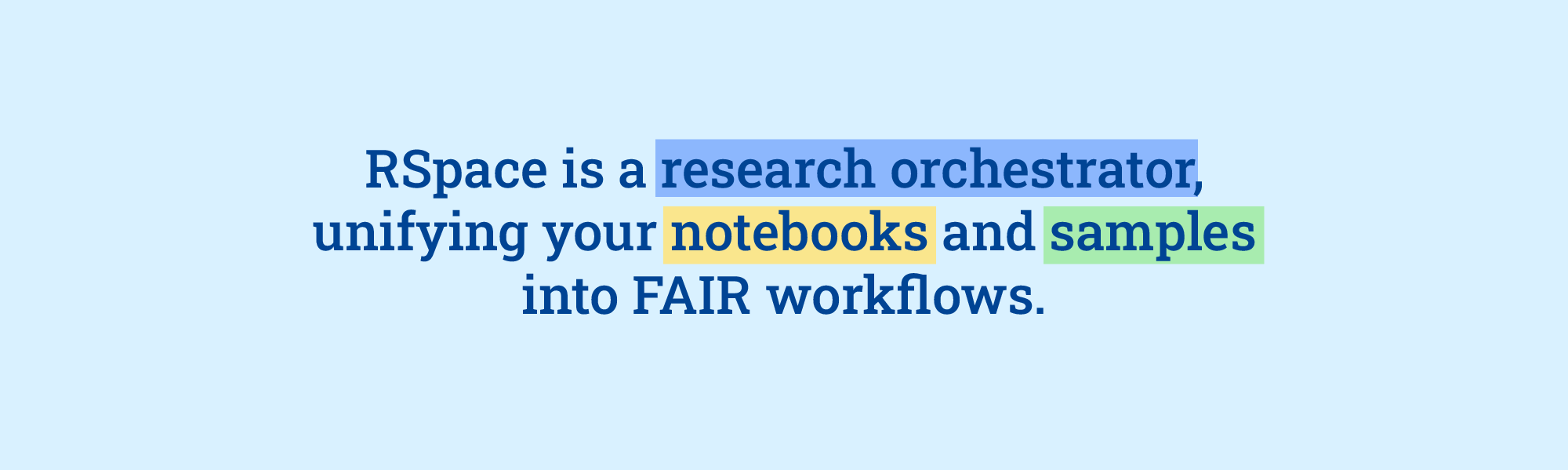
RSpace connects institutional storage and compute, supports 20+ integrations (Galaxy, Dataverse, iRODS, DMPTool and more), and provides native support for persistent identifiers, ontologies, and metadata standards — ORCID, RAiD, IGSN ID, ROR, PIDINST (soon), RO-Crate — directly in research workflows. As such, RSpace helps to streamline research workflows across tools and services, fostering adoption and efficient use of research infrastructure and FAIR practices.
→ Learn more about the Research Orchestrator
Planning research, recording progress and experimental/study context, and collecting data are daily activities, all research has in common. This puts tools like ELNs on top of funnel towards creating FAIR data and greatly reduce the effort of FAIRifying data post-creation. RSpace helps with these activities as a collaborative, generalist research notebook with native chemistry workflows, integrated inventory, and workflows with tools researchers already use.
Managing physical objects, such as samples, is another starting point for researchers to adopt FAIR digital research practices right at the beginning of their research. RSpace features a mobile-first, visual inventory system for managing samples at scale — including offline field collection workflows and IGSN ID support for FAIR sample publication. And of course, it’s tightly integrated with the ELN features in RSpace.
→ Learn more about Sample Management

The new logo — a three-coloured cube — is a small visual cue to this shift. Each face represents one facet of our vision, tightly integrated with each other.
If your institution is thinking about where research notes, physical objects, and infrastructure connect we’d love to talk.
RSpace is an open-source platform that orchestrates research workflows into FAIR data management ecosystems: request a demo or contact us to learn more.
July 28, 2026
Research documentation in the age of AIResearch Data Management
A personal reflection on AI, RSpace, and how we can start addressing provenance for AI agents as collaborators in research.
Read moreJune 23, 2026
Chemistry in RSpace: What a Year of Open-Source Development Looks LikeProduct Updates
A year after transitioning RSpace's chemistry tools to an open-source stack, we look at what has been built since: an open chemistry codebase on GitHub, PubChem compound import directly from documents, and stoichiometry tables connected to inventory management. We also preview what comes next, including chemistry-aware metadata in exports to generalist and domain repositories.
Read moreJune 9, 2026
What Core Facilities Can Get Out of Implementing RSpaceResearch Data Management
How core facilities in research institutions can leverage RSpace to manage documentation, user agreements, and multi-project workflows across diverse research groups.
Read moreJune 9, 2026
How RSpace Structured Templates Can Transform Your Lab DocumentationResearch Data Management
A look at how structured templates and forms in RSpace can streamline lab documentation, reduce errors, and help research groups build a shared knowledge base.
Read more