
Research Data Management
During my own time in research, documentation was a patchwork effort: printed data sheets for fermentation runs and protein production, spreadsheets for managing plasmids, purified proteins, cell cultures, data on personal and instrument computers, and of course a paper notebook to hold it all together. It's not hard to imagine how this introduces challenges for finding something again later, sharing data with colleagues, and getting people to adopt the same workflows for efficient collaboration and research.
RSpace wasn't something I had access to then. When I joined the ResearchSpace team, I reflected on what those workflows could have looked like — and built a few templates to show it: run sheets for fermentation and protein purification, spectroscopic experiments, inventory records for samples. The kinds of things that let a new lab member hit the ground running and enable building a shared research knowledgebase.
To show what this looks like in real practice, I want to share the experience of one of the researchers we worked with to build out the initial content for an RSpace template repository.
"During my time as a biochemistry PhD student studying the molecular signatures of skeletal muscle atrophy, I spent much of my day picking up the fragments of weeklong experiments — setting up PCRs, passaging cells, running SDS-PAGE gels and developing blots. Making sense of the experiments later depended entirely on how well I documented them in a traditional handwritten lab notebook, but my "lab book" was a series of back-to-back experiment snippets, sorted chronologically, which required careful attention to parse the entirety of each experiment after a week. With the transition into RSpace, all documentation could be sorted by experiment without needing to plan for how many pages I would need, were immediately legible, searchable and linked to other experiments.
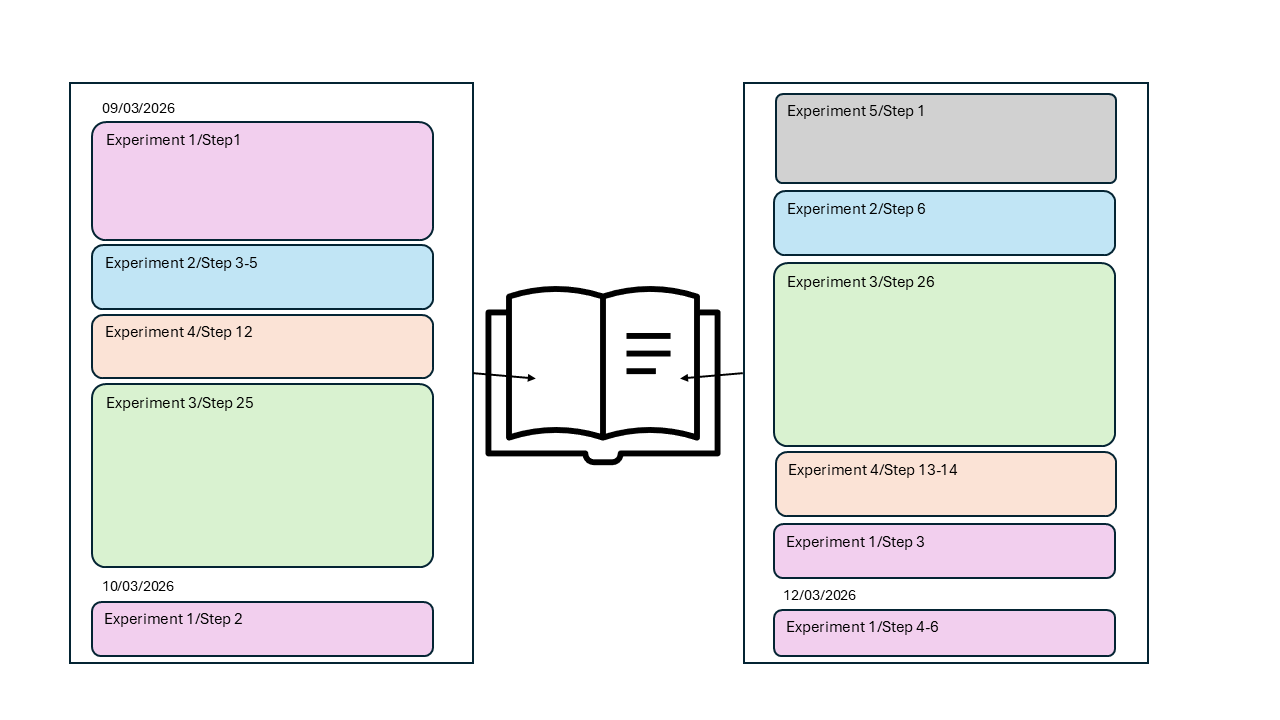
Over the course of 3 years during my PhD, I became a heavy user of RSpace. The switch was propelled by the uncertainty of lab access during the Covid-19 pandemic and the fact I burned through one notebook every 6 months. An additional upside of ELN adoption was a more flexible work style: I could finish up the documentation during the experiments or work from home.
My digital workspace was sorted by folders (named by techniques), within it several documents with dates and a brief title. Looking back, a better way to organize it would be by projects and within it, experiments. Unfortunately, I didn't know back then that forms/templates can streamline the documentation process even more as I found copy-pasting easy enough compared to re-writing entire protocols with modifications as I did in my paper lab notebook times.

Since then, I have created templates and forms which can be used by others to facilitate their daily RSpace documentation. To clarify the difference between the two, a template is a saved document you can make from a fully written page for quick access. A form is created via "Create form" in "My RSpace" and is created with several entry fields specified by entry value (string, date, text, number etc.). Once created, forms can also be converted and stored as a template where one can then export it as a .ZIP or .ELN file for others to use by importing.
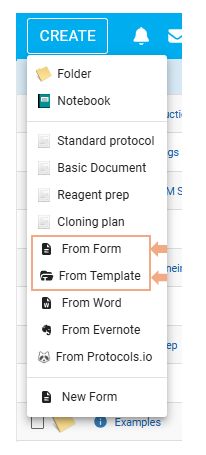
By having forms/templates, a strict entry structure can be implemented across your lab group. This minimises errors introduced through copy/pasting, reduces loss of crucial experimental detail and enforces some uniformity in documentation.


2. Faster documentation – Templates
Templates allow you to quickly enter new documentation based on a previously created one. They reduce the time required to set up a new document from scratch or duplicate an entry containing the protocol which you just repeated with minor modifications.
3. Paperwork management – Forms
For users from core facilities, forms allow you to incorporate RSpace for management of user agreements, project description forms and service request forms. This centralises the storage of experimental documentation together with project paperwork on RSpace and enables seamless sharing with the rest of your team, reducing email communications.
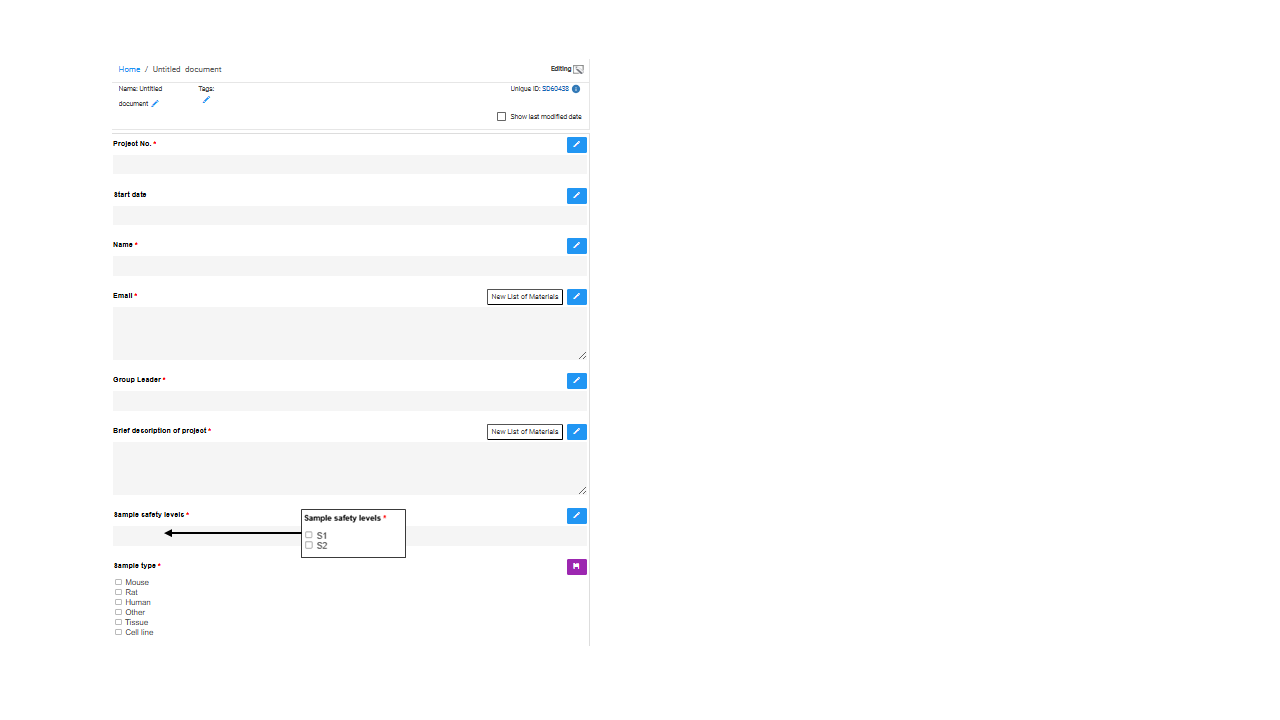
Later on, one can filter and search for the documents created with the same form and export a batch of documents as a .CSV file. These small investments in structure pay off every time a new lab member inherits your workflows, or when you need to make sense of an experiment from six months or years ago."
All of the examples discussed in this post and more are part of the new RSpace community template repository — a collection of document templates, inventory examples, and controlled vocabularies covering real research workflows and now open to the community.
The repository includes document templates (structured templates for experiments, protocols, and lab administration, ready to import into RSpace as .ZIP or .ELN files), inventory examples (reference CSVs showing how others have structured sample metadata for plasmids, cell lines, reagents, and more), and vocabularies (controlled term lists for standardising tags across your RSpace instance).
If you've built a template that has helped your workflow, we'd love to have it in the collection. See the contributing guide for how to submit.
RSpace is an open-source platform that orchestrates research workflows into FAIR data management ecosystems: request a demo or contact us to learn more.
July 28, 2026
Research documentation in the age of AIResearch Data Management
A personal reflection on AI, RSpace, and how we can start addressing provenance for AI agents as collaborators in research.
Read moreJune 23, 2026
Chemistry in RSpace: What a Year of Open-Source Development Looks LikeProduct Updates
A year after transitioning RSpace's chemistry tools to an open-source stack, we look at what has been built since: an open chemistry codebase on GitHub, PubChem compound import directly from documents, and stoichiometry tables connected to inventory management. We also preview what comes next, including chemistry-aware metadata in exports to generalist and domain repositories.
Read moreJune 9, 2026
What Core Facilities Can Get Out of Implementing RSpaceResearch Data Management
How core facilities in research institutions can leverage RSpace to manage documentation, user agreements, and multi-project workflows across diverse research groups.
Read moreApril 21, 2026
Introducing The Guide to the RSpace ProjectOpen source
We're launching The Guide to the RSpace Project - a new community resource covering how to contribute to, understand, and engage with RSpace as an open source project, developed with support from the Birdaro training program.
Read more